








By Ahmed Musa | Asiwaju Media Team
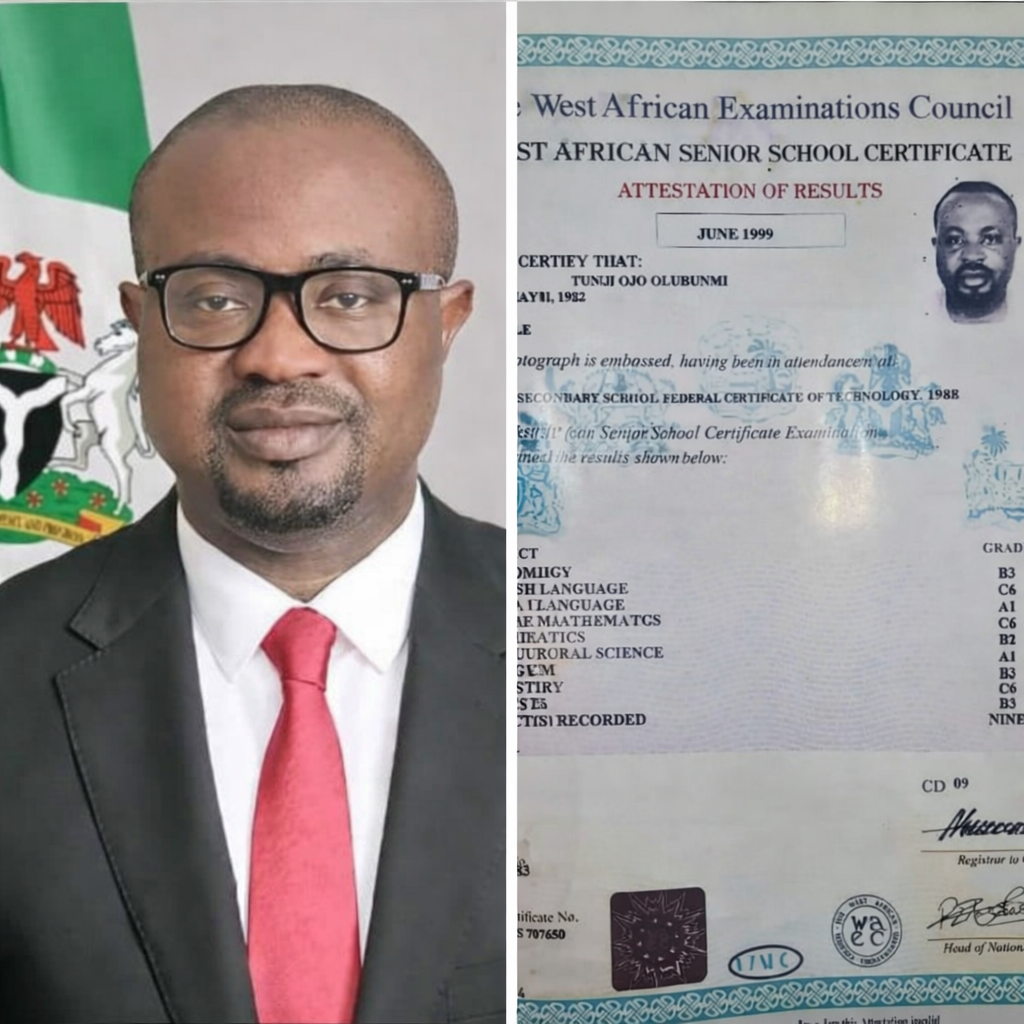
Allegations surrounding the academic and service records of Nigeria’s Minister of Interior, Hon. Olubunmi Tunji-Ojo, have intensified following the resurfacing of a controversial WAEC Attestation of Results purportedly issued in respect of his claimed participation in the 1999 Senior School Certificate Examination (SSCE).
The renewed controversy comes amid growing public scrutiny of inconsistencies relating to the minister’s WAEC certificate, age declaration, passport photograph, and NYSC mobilisation history, with critics insisting that the emerging details further strengthen long standing allegations of irregular documentation.
Disputed WAEC Claim and Age, Appearance Discrepancy
The WAEC document in circulation indicates a date of birth of 1 May 1982, which would place the candidate at approximately 17 years old during the June 1999 examination diet. However, the passport photograph affixed to the document has generated significant controversy.
Observers note that the individual in the photograph appears to possess fully developed facial hair, mature facial structure, and signs of a receding hairline, features widely considered inconsistent with the physical appearance of a typical 17 year old. This has raised legitimate questions as to whether the photograph represents the candidate at the time of the examination or whether a later image or an entirely different individual was substituted.
Private Forensic Observation Raises Red Flags through a private forensic observer, Dr. Fred Nintendo, a UK based analyst, reportedly conducted a visual and contextual review of the WAEC result sheet. According to him, the document exhibits characteristics consistent with what he described as a non-expert or amateur forgery, noting that Nigeria’s common forgery techniques often leave identifiable visual and procedural inconsistencies.
While Dr. Nintendo’s assessment does not constitute a judicial determination, it has added weight to calls for official verification by WAEC with the Questionable Photograph Integration and Embossing
The document asserts that the attached photograph is embossed. However, visual inspection reportedly shows no clear continuity of embossing across both the photograph and the paper substrate.
In standard WAEC issued certificates, embossing typically creates visible relief patterns intersecting both the document body and the photograph, serving as a security feature. The apparent absence of such interaction has raised concerns that the photograph may have been affixed or replaced after issuance, rather than being originally integrated.
Use of Attestation of Results for a 1999 Examination further as questions arise from the fact that the document is styled as an Attestation of Results for a 1999 examination diet. Attestations are generally issued years after examinations, often as replacements where original certificates are lost or damaged.
This raises uncertainty about when the document was produced, under what circumstances, and whether it reflects an original contemporaneous record or a later reconstruction, the basis of which remains unclear.
Printing, Typography, and Production Irregularities
Visual inspection reportedly reveals minor alignment irregularities and variations in text sharpness across sections of the document. Experts note that certificates produced in a single secure printing process typically display uniform typography, alignment, and print density.
Such inconsistencies may suggest multi stage printing, later digital insertion, or post production alteration, rather than issuance through a single controlled process.
Critics argue that there is no publicly available evidence conclusively establishing continuity between the individual who allegedly sat for the WAEC examination in 1999
The individual depicted in the passport photograph
In the absence of WAEC biodata records, original entry forms, or contemporaneous passport photographs, concerns persist regarding possible identity substitution or post examination alteration.
Ultimately, the authenticity of the document depends entirely on WAEC’s internal records, including candidate biodata, original passport photographs, and issuance logs. Without official confirmation from WAEC, the document cannot be independently verified and remains susceptible to allegations of irregular procurement or manipulation.
Taken collectively, these observations present reasonable grounds for suspicion that the certificate may not have been acquired through a regular, contemporaneous examination and issuance process, subject to confirmation or refutation by the issuing authority.
The controversy extends beyond WAEC. According to Barrister Usani, who reacted publicly to the growing tension, the minister’s educational history is marked by what he described as a pattern of implausible explanations.
He cited claims attributed to Tunji-Ojo that he was mobilised for NYSC while residing in London in 2006, allegedly remobilised in 2019 while serving as an elected member of the National Assembly, and that his NYSC certificate was printed in 2023 in preparation for ministerial screening.
Barr. Usani condemned what he described as a systematic presentation of questionable credentials, asserting that the pattern raises doubts about the existence of any verifiable academic or service records.
Reacting to the latest development, Engr. Atere, an APC stakeholder, stated that the party has distanced itself entirely from the controversy, placing responsibility squarely on the minister.
According to him, the party has not authorized or defended the certificates in question, noting that even the minister himself has struggled to provide a convincing defence, a situation he said speaks volumes to informed observers.
He further alleged that certain individuals, whom he described as including the educated illiterates, have been engaged and allegedly paid 2m Naira each to defend the documents on social media, a move he insisted does not represent the position of the APC.
As pressure mounts, observers insist that only transparent disclosure and independent verification by WAEC and NYSC can bring clarity to the matter. Until such records are produced, the allegations surrounding Olubunmi Tunji-Ojo’s credentials are likely to remain a subject of public concern, political tension, and legal scrutiny.
All allegations remain subject to investigation, and the affected parties retain the right of response.


