







By Dada Ayoola | Asiwaju Media Team
Abuja, Nigeria – Multiple allegations of financial impropriety, contract fraud, forgery and irregular academic credentials against the Minister of Interior, Olubunmi Tunji-Ojo, have triggered sustained pressure from civil society, political figures and legal experts across Nigeria. Rather than directly addressing these mounting claims, the minister’s prolonged silence has fuelled criticism, with stakeholders describing the situation as an embarrassment to both the Ministry of Interior and the Federal Government.
At the heart of the controversy are assertions that Tunji-Ojo, a key figure in President Bola Ahmed Tinubu’s administration entrusted with national internal security, has failed to adequately clarify serious allegations, some of which involve hundreds of millions of naira in questionable contract awards.
Central to the allegations are contracts awarded by the now suspended Ministry of Humanitarian Affairs, where documents indicate that New Planet Projects Limited received approximately ₦438 million in consultancy fees linked to a contentious ₦3 billion social register contract while Dr. Betta Edu was minister. Bunmi Tunji-Ojo has been invited by oversight bodies to explain his links to the company, which he has said he resigned from years earlier, though questions remain over the timing and his ties to the firm.
Senior legal practitioner Bar. Usani SAN weighed in when reacted about the contract fraud claims that also saw Dr. Betta Edu suspended and referred for investigation. Bar. Usani argued that the minister’s evasion of direct clarification undermines public confidence and raises significant concerns for the integrity of governance in Nigeria. He noted allegations that, instead of confronting these issues transparently, the minister has been allegedly distributing funds of ₦2 million to individuals across the country, a claim circulating widely on social media and public discourse even as official confirmation remains unverified. According to Usani, such actions by a sitting federal minister, particularly one in charge of internal security, would prompt intense international scrutiny if conducted by a member of the president’s immediate family.
The senior lawyer further criticized anti-corruption institutions such as the Economic and Financial Crimes Commission (EFCC) and the Independent Corrupt Practices and Other Related Offences Commission (ICPC), suggesting they have failed to act decisively in the face of these allegations, unlike the handling of former ministers under previous administrations.
Engr. Benson Atere, a chieftain of the ruling All Progressives Congress (APC), described the situation as worsening and stressed that the party has publicly distanced itself from the controversies surrounding Tunji-Ojo, asserting that the matter transcends partisan politics and touches on national governance credibility. In a similar vein, APC sources have at times dismissed some criticisms as politically motivated, though such responses have done little to quell public concern.
Alhaji Gamba Gololo, another APC insider, sharply criticized how the minister appears to be treated differently from other officials. Gololo stated that while EFCC had previously invited Tunji-Ojo to answer questions about fraudulent contracts, he allegedly did not honour the invitation, a situation Gololo described as emblematic of selective justice. According to him, other ministers from the previous administration, including those from late President Muhammadu Buhari’s cabinet and a former Central Bank governor, were detained and prosecuted for fraud, he questions why similar rigor has not been applied in Tunji-Ojo’s case.
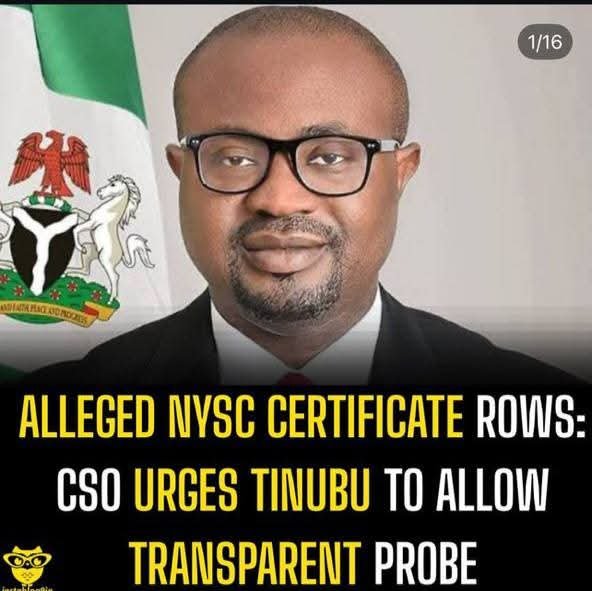
On the academic front, suspicions about the authenticity of Tunji-Ojo’s National Youth Service Corps (NYSC) certificate have circulated for months. Critics raised concerns that the timing and issuance of his NYSC certificate did not align with his reported service period. The NYSC has publicly confirmed the authenticity of the certificate presented by Tunji-Ojo, explaining that he was first mobilised in 2006, later remobilised in 2019 after absconding, and eventually issued a certificate in February 2023 due to administrative delays. Questions remain about how he fulfilled service obligations while holding public positions.
Despite official clarification from the NYSC, groups such as the League for Good Governance, Integrity Group, and the Asiwaju Media Team have demanded full transparency, urging President Tinubu to allow independent scrutiny of the minister’s records to dispel public doubt.
Legal experts maintain that Nigeria’s rule of law requires public officials accused of document irregularities or financial misconduct to either clear their names or face full legal processes. Observers point to precedents where ministers embroiled in certificate scandals stepped down to preserve institutional credibility. Critics argue that failure to address the allegations transparently could erode confidence in anti-corruption efforts and the integrity of the Tinubu administration.
As the controversy continues to generate domestic and international attention, calls for clarity and accountability have intensified. Civil society actors insist that a senior official in charge of internal security must address both financial integrity and credential legitimacy directly, rather than through proxy statements or silence. With Nigeria grappling with security challenges and economic pressures, the stakes of leadership credibility have never been higher.


