


Dada Ayoola | Asiwaju Media Team
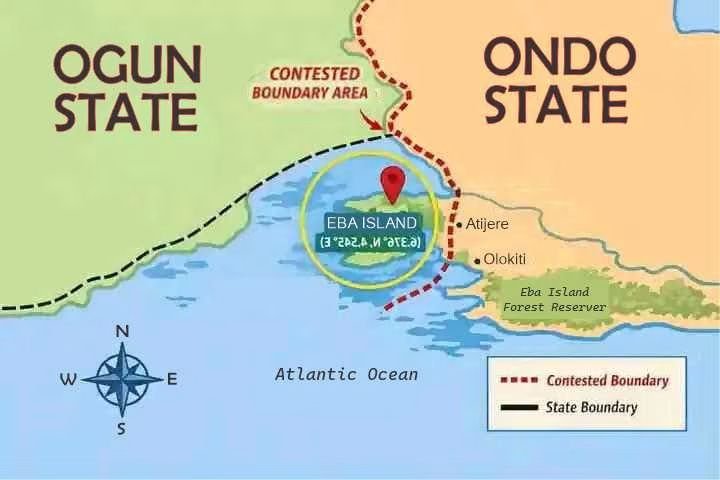
Eba Island, a riverine and forested territory located near Atijere in Ilaje Local Government Area of Ondo State, has in recent times become the centre of an intense inter state dispute following reports of hydrocarbon presence in the area. The controversy, now drawing national attention, pits Ondo State against Ogun State, with the latter, particularly some Ijebu interests laying claims widely criticised as historically unfounded and administratively misleading.
Eba Island lies within the estuarine coastal belt of Southwestern Nigeria, close to where Ondo and Ogun States converge near the Bight of Benin. Its strategic importance escalated sharply after media reports indicated the discovery of oil deposits in the area, instantly transforming what had long been a quiet, Ondo administered territory into a contested zone.
Available historical, colonial, and post colonial records overwhelmingly situate Eba Island within Ilaje land of Ondo State, long before the emergence of modern digital maps or contemporary political interests.
Pre-1914 (Colonial Era) which is before the amalgamation of Northern and Southern Nigeria, Eba Island and its surrounding communities formed part of Ilaje/Mahin country, administered under the defunct Lagos Colony. This predates the creation of Ogun State or any Ijebu administrative claim to the territory.
Post Amalgamation (1914 onwards), following amalgamation, the area was absorbed into Ondo Province, administered under the Okitipupa Division, and governed locally through the Atijere Native Authority, a clear administrative trail linking the island to Ilaje territory.
By around 1950, Eba Island was formally incorporated into the Ilaje District Council, headquartered in Atijere.
When Ilaje/Ese-Odo Local Government Area was created in 1975, Eba Island remained within its jurisdiction.
After the 1997 split that created Ese-Odo LGA, the island continued to be administered by Ilaje LGA of Ondo State without dispute.
Traditional institutions on and around Eba Island like Baales and community leadership structures, have historically been appointed and recognised under Ilaje and Ondo State authorities. Infrastructure development, forestry reserve management, public services, and governance activities have, for decades, been consistently provided by Ondo State, further reinforcing uncontested occupation and control.
Where Ogun State Went Wrong is the discovery of oil between their neighbours due to jealousy. The current Ogun State claim, according to Ondo and Ilaje stakeholders, stems not from history, occupation, or lawful administration, but from misinterpretation of digital boundary representations, particularly Google Maps overlays, and jealousy of oil discovery.
Unlike statutory boundary instruments, Google Maps relies on aggregated digital data and approximations that do not constitute legal or historical authority. Critics argue that Ogun officials and some Ijebu traditional interests substituted cartographic visuals for colonial gazettes, administrative records, and physical occupation, thereby creating a false impression of ownership.
While Ogun State officials cite what they describe as Boundary Commission maps, no final, gazetted determination by the National Boundary Commission, no court judgment, and no constitutional instrument has formally transferred Eba Island from Ondo State to Ogun State.
A Case of Digital Error Versus Historical Reality
Analysts describe the situation as a classic case of digital boundary illusion overriding historical fact. Boundary determination in Nigeria is grounded in Colonial and post colonial administrative records, Recognised traditional authority, Longstanding governance and occupation. By these standards, Eba Island’s linkage to Ilaje, Ondo State, remains clear and continuous.
The Eba Island controversy highlights the danger of elevating Google Map interpretations above documented history and lawful administration. Until a competent authority, such as the National Boundary Commission or a court of law rules otherwise, the historical record shows Eba Island as an integral part of Ilaje land in Ondo State.
Observers warn that continued reliance on artificial digital boundaries, rather than established legal and historical evidence, risks unnecessary tension in a region where coexistence had long been settled before the discovery of oil brought new interests into play.
