


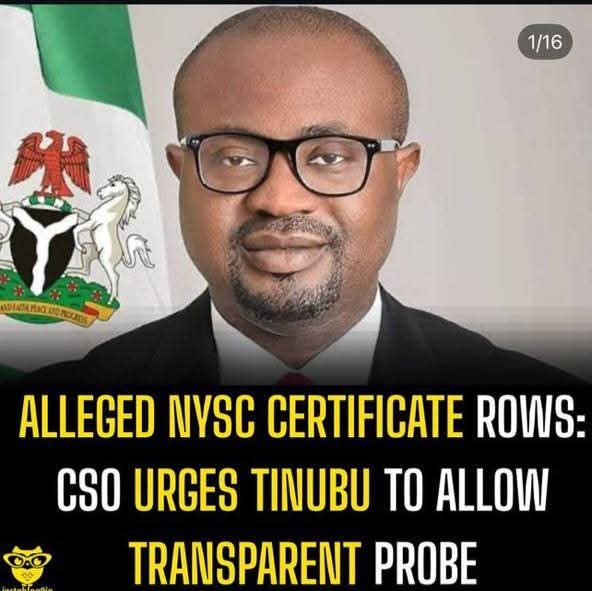
Editorial | Asiwaju Media Team
Nigeria is again confronted with a troubling question that goes far beyond partisan politics or personal loyalty. It is a question about truth, records, and whether the law still applies equally to those in power.
The unresolved controversy surrounding the academic credentials and NYSC mobilisation of the Minister of Interior, Hon. Olubunmi Tunji-Ojo, has refused to disappear for one simple reason which is the facts, as publicly known, do not align.
In 2019, records attributed to the National Assembly election indicate that an SSCE (WAEC) attestation was submitted as part of the Minister’s credentials. The law permits the use of SSCE for electoral qualification. That point is not in dispute.
What is in dispute is that in the same year, the Minister was reportedly remobilised for National Youth Service Corps (NYSC) service, a process that legally requires the completion of a tertiary institution. An SSCE certificate alone does not meet that requirement.
One cannot, within the same timeline, rely on SSCE as the highest qualification for electoral purposes and simultaneously be eligible for NYSC mobilisation, which presupposes a degree or HND. Either one record is incomplete, or another is inaccurate. Both cannot be true.
Yet, despite the seriousness of this inconsistency, the institutions responsible for clarity have chosen silence. NYSC has not publicly released the academic basis for the remobilisation. WAEC has not verified or clarified the SSCE attestation reportedly used. Relevant authorities have offered no comprehensive account.
.
In a country where young graduates are denied service or certificates over minor discrepancies, institutional quietude in the face of far graver contradictions sends a dangerous message that scrutiny depends not on facts, but on status.
This matter is no longer about one individual. It is about whether documentation still matters, whether timelines still matter, and whether the law is still blind. When institutions refuse to speak, suspicion fills the vacuum. When suspicion hardens, public trust erodes.
Nigeria cannot afford selective accountability. If records can be bent for the powerful while rigidly enforced against the powerless, then democracy becomes hollow and the rule of law becomes negotiable.
The solution is simple and lawful. WAEC must verify the SSCE attestation. NYSC must publish the academic qualifications relied upon for mobilisation or remobilisation. Where discrepancies exist, due process must follow.
This is not persecution. It is governance.
Until clear, verifiable records are produced, the questions will remain, not as political noise, but as a stain on institutional credibility. And in a democracy, credibility is not optional.
