


By Emorioloye Owolemi | Asiwaju Media Team
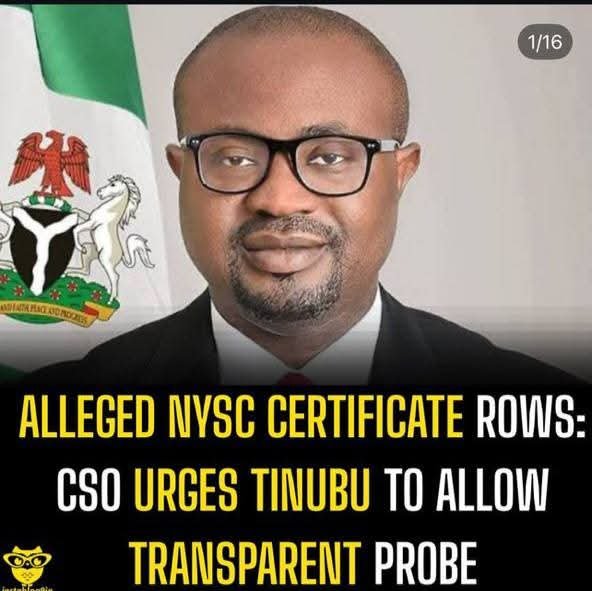
A fresh wave of controversy is engulfing the Ministry of Interior as civil society organisations, legal practitioners, and public affairs observers intensify pressure on President Bola Ahmed Tinubu to order an independent review of the academic records, service history, and official conduct of the Minister of Interior, Hon. Olubunmi Tunji-Ojo.
The renewed agitation follows a formal petition submitted to the President by Lagos based law firm, Goodman Che Solicitors, over what it described as the failure and refusal of the National Youth Service Corps (NYSC) to release the minister’s service records in response to a Freedom of Information (FOI) request.
In a letter dated 19 November 2025 and addressed to President Tinubu at the Aso Rock Presidential Villa, the firm stated that it was acting on behalf of Igbega Foundation, a civil society organisation seeking clarity on Hon. Tunji-Ojo’s NYSC mobilisation, deployment, and service history.
According to the petition, Amofin Solicitors, counsel to the foundation, had earlier written to the Director General of the NYSC on 5 November 2024, pursuant to Sections 1 and 3 of the Freedom of Information Act, requesting access to official documents connected to the minister’s educational and service credentials.
The FOI request reportedly sought records relating to Hon. Tunji-Ojo’s West African Examination Council (WAEC) Senior Secondary School Certificate, allegedly obtained in 1991, as well as his Certificate of National Service dated 23 February 2023, alongside other supporting educational qualifications.
The continued silence and non-disclosure by the NYSC have since escalated public concern, with critics arguing that lingering questions around the minister’s credentials cannot be ignored in a democracy anchored on transparency, accountability, and the rule of law.
Public commentators insist that qualification integrity is inseparable from public service credibility, warning that allegations touching on possible forgery or misrepresentation of WAEC, NYSC, bachelor’s, and master’s degree certificates, if eventually substantiated, would pose serious questions about the legitimacy of official decisions taken under the minister’s authority and the integrity of the institutions involved.
Beyond credentials, attention has also turned to the performance record of the Interior Ministry, particularly its widely publicised fast track passport initiative, which initially attracted public praise for easing passport issuance.
Critics now argue that the initial optimism has faded, citing reports of increased scrutiny, visa denials, and entry restrictions faced by Nigerian passport holders in several countries, with the United States frequently referenced as a major destination where Nigerian travellers face heightened checks.
They contend that these developments have raised deeper concerns about Nigeria’s international image, border management, and internal security, all of which fall squarely within the constitutional responsibilities of the Interior Ministry.
While acknowledging that the allegations against Hon. Tunji-Ojo remain unproven, critics maintain that public confidence in governance requires openness, insisting that an independent, lawful, and transparent review is necessary to clear the air and protect institutional integrity.
Offering a legal perspective, a Senior Advocate of Nigeria (SAN), Barrister Usani, commended President Tinubu’s ongoing tax reforms, describing them as bold, forward-looking, and potentially transformative for Nigeria’s economy.
However, Barr. Usani expressed strong reservations about allowing a minister facing unresolved integrity questions to retain influence over sensitive national policy areas, particularly those involving citizens’ personal and biometric data.
He specifically warned against the Interior Ministry’s role in policies linking National Identification Numbers (NINs) with banking, tax, and financial systems, stressing that such responsibilities demand unquestionable credibility.
“Assigning the integration of Nigerians’ NINs with banking and tax systems to a ministry headed by a minister whose credentials remain under serious public questioning is a risk the nation should not take,” Barr. Usani cautioned.
He added that until Hon. Tunji-Ojo provides clear explanations supported by verifiable documentation from relevant authorities, prudence demands that he should not oversee responsibilities of such national sensitivity.
Also reacting, Dr. Oladoyin Odebowale, former senior aide to the late Governor Oluwarotimi Akeredolu, openly challenged Hon. Tunji-Ojo to personally defend the certificates he claims to possess, if indeed they exist as stated.
Odebowale warned that placing control of Nigerians’ NIN data under a minister who has not publicly addressed allegations of forgery and credential discrepancies is dangerous and irresponsible, urging immediate clarification.
As of the time of filing this report, Hon. Olubunmi Tunji-Ojo, the NYSC, WAEC, and other relevant government agencies have not issued any official response addressing the allegations, FOI concerns, or calls for an independent review.
