


By Olanipekun Ademola | Asiwaju Media Team
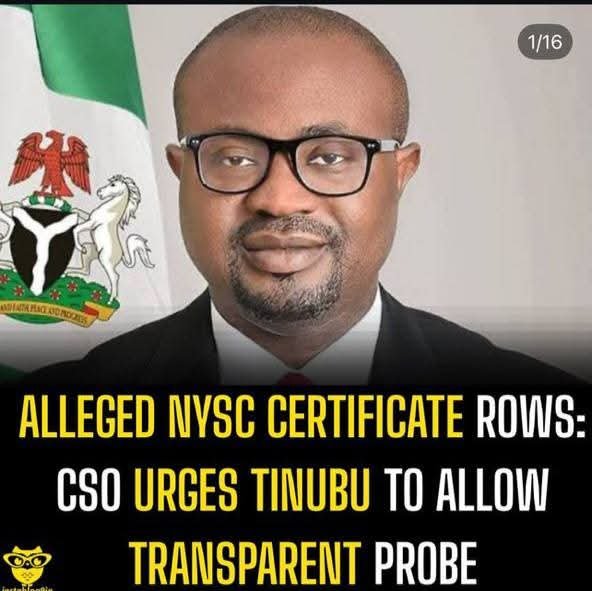
Nigeria’s democracy is anchored on the rule of law, institutional accountability, and the integrity of public office holders. When serious allegations arise against a serving minister, particularly one entrusted with internal security, such issues transcend partisan debate and enter the realm of national concern. This is the context within which the unresolved allegations surrounding the Minister of Interior, Hon. Olubunmi Tunji-Ojo, must be examined.
The National Youth Service Corps (NYSC) scheme is, by law, a one year mandatory national service for eligible Nigerian graduates. In the history of Nigeria, there is no known statutory provision that permits an individual to undergo NYSC service spanning 17 years.
Publicly circulating claims suggesting that Hon. Tunji-Ojo’s NYSC service stretched from 2006 to 2023 raise grave questions that demand official clarification. If such a claim were ever to be substantiated, it would not merely be an administrative irregularity but an unprecedented distortion of a national institution. For reasonable Nigerians, the implication is stark that if a serving Minister can claim a 17-year NYSC service without consequence, then the credibility of the system itself is in jeopardy.
Under Nigerian law, particularly the NYSC Act, any falsification, alteration, or misrepresentation of NYSC records constitutes a criminal offence, punishable upon conviction. It is therefore in the interest of both the Minister and the nation that these claims be independently investigated and either conclusively disproved or appropriately sanctioned.
Compounding the controversy are unofficial reports that London Metropolitan University has stated that it has no academic records corresponding to Hon. Tunji-Ojo, despite inquiries reportedly made to the institution to release any available documentation.
It must be emphasized that allegation is not conviction. However, in public service, especially at ministerial level, the standard is not merely legality but transparency. Where academic credentials are questioned, silence or delayed response only deepens public suspicion. The proper course is a transparent, document backed clarification from all relevant institutions.
As Minister of Interior, Hon. Tunji-Ojo oversees critical agencies responsible for internal security, immigration control, civil defence, and national identity management. While the administration has highlighted improvements in passport issuance, critics argue that administrative efficiency in one area cannot substitute for credibility in character.
In democratic practice, when allegations of this magnitude confront a security sensitive office holder, temporary relief from office pending investigation is a globally accepted safeguard. It protects the integrity of the office, the investigation process, and the administration itself.
Further public concern stems from allegations linking Hon. Tunji-Ojo to a financial transaction involving ₦585 million, a sum widely reported in connection with the humanitarian affairs scandal that led to the dismissal of Dr. Betta Edu, former Minister of Humanitarian Affairs.
While Dr. Edu was promptly relieved of her duties to allow investigation, critics question why the same standard has not been visibly applied to Hon. Tunji-Ojo, despite public references to his name in related allegations. To date, there has been no judicial determination of guilt, but the principle of equal treatment before the law remains central to public confidence.
In response to these unresolved matters, party stakeholders and civil voices have reportedly called on President Bola Ahmed Tinubu to urgently intervene. Their appeal is not framed as a political attack but as a plea to protect Nigeria’s institutional integrity and the credibility of an administration elected on promises of accountability and reform.
Protests have been announced by concerned groups, underscoring the depth of public dissatisfaction and the perception that unresolved allegations are damaging Nigeria’s international image.
