






By Ilesanmi Mobolaji | Asiwaju Media Team
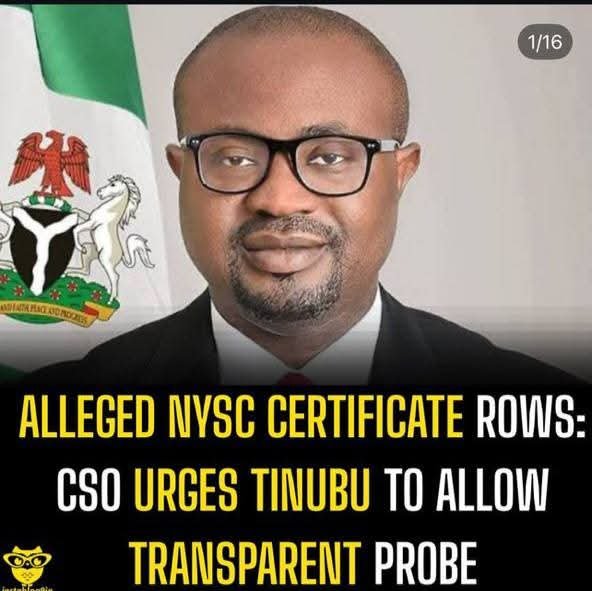
Allegations surrounding the academic credentials of Nigeria’s Minister of Interior, Hon. Olubunmi Tunji-Ojo, have refused to fade, not because of rumor or speculation, but due to a glaring inconsistency that strikes at the heart of public trust, institutional integrity, and the rule of law.
At the centre of the controversy is a disturbing timeline conflict involving two critical national processes, electoral qualification and National Youth Service Corps (NYSC) mobilisation.
In 2019, Hon. Olubunmi Tunji-Ojo allegedly contested and won a seat in the National Assembly. Records and documents attributed to that election indicate that an SSCE (WAEC) attestation was submitted as part of his credentials to the electoral body. Under Nigerian law, the use of SSCE for electoral qualification is permissible for certain offices.
However, in the same year (2019), Hon. Tunji-Ojo was reportedly remobilised for NYSC service.
This is where the contradiction becomes impossible to ignore.
NYSC mobilisation, by law and long standing administrative practice, requires the completion of a tertiary institution, typically evidenced by a degree or Higher National Diploma (HND). An SSCE certificate alone does not qualify any individual for NYSC mobilisation or remobilisation.
The unresolved question, therefore, is simple but damning on how could the same individual, in the same year, rely on an SSCE attestation for electoral purposes and yet be deemed eligible for NYSC remobilisation, which presupposes a completed tertiary education?
This contradiction raises serious and legitimate concerns about the authenticity of the academic qualifications presented
The accuracy of the timeline of educational attainment
The legality of the NYSC remobilisation process
Possible falsification, alteration, or backdating of records
If a tertiary qualification existed before 2019, why was an SSCE attestation reportedly used for the National Assembly election?
Conversely, if the SSCE was the highest qualification at the time, on what legal basis did NYSC approve remobilisation?
More troubling than the allegations themselves is the apparent institutional silence surrounding them. Despite the gravity of the claims, no comprehensive clarification has been issued by
The National Youth Service Corps (NYSC)
The West African Examinations Council (WAEC)
Relevant electoral or investigative authorities
This silence has fueled public suspicion of what many observers describe as a protective magic, an unseen but powerful shield that appears to insulate certain political office holders from the level of scrutiny routinely applied to ordinary citizens.
In a country where young graduates are denied NYSC clearance over minor discrepancies, and where candidates are disqualified for far less, the absence of transparency in this case sends a deeply damaging message.
For the sake of national integrity and public confidence, this matter can no longer be treated as political noise.
There is a clear and urgent need for WAEC to publicly provide clarification and verification of the SSCE attestation allegedly used in 2019.
NYSC to release the full mobilisation or remobilisation records, including the academic qualifications relied upon.
Relevant law enforcement and prosecutorial agencies to examine the documents for possible forgery, misrepresentation, or abuse of process, where applicable.
This is not a call for persecution, but for due process.
Nigeria cannot continue to demand honesty from its citizens while appearing to excuse ambiguity at the highest levels of power. If institutions are selectively blind, the law becomes selective. And when the law is selective, democracy itself is wounded.
Until clear, verifiable records are produced, the questions surrounding Hon. Olubunmi Tunji-Ojo’s credentials will remain not just unanswered, but emblematic of a deeper crisis,.a system where truth bends, and accountability waits at the gate, denied entry.


