







By Dada Ayoola | Asiwaju Media Team
Nigeria is once again confronted with a credibility crisis that strikes at the heart of governance, national security, and public trust, as unresolved allegations surrounding the academic and National Youth Service Corps (NYSC) records of the Honourable Minister of Interior, Olubunmi Tunji-Ojo, continue to generate nationwide tension.
For weeks, public discourse has been dominated by claims that the minister’s SSCE (WAEC), bachelor’s degree, NYSC certificate, and master’s degree cannot be independently and credibly verified, with critics alleging that the documents presented in his name are inconsistent, irregular, or forged. Despite the gravity of these allegations, the minister has yet to publicly present original credentials or submit himself to an independent forensic verification process.
In a leaked briefing attributed to a senior APC chieftain close to the Presidency, concerns were expressed in unusually blunt terms. The briefing stated that “Hon. Olubunmi Tunji-Ojo’s academic and NYSC forgery allegations have continued to embarrass our administration and party. No SSCE WAEC, no bachelor’s degree, no NYSC certificate, and no master’s degree have been credibly established in his name as claimed; all are alleged to have been forged. Considering the sensitivity of the Interior Ministry, it is unreasonable to suggest that, among millions of Nigerians, there is no competent individual capable of replacing Tunji-Ojo.”
This internal alarm has only deepened public anxiety, as it suggests that the controversy is no longer confined to opposition voices or social media critics but has permeated the ruling party’s inner circles.
The Ministry of Interior oversees some of the most critical pillars of Nigeria’s internal security architecture, including immigration, citizenship, passports, civil registry, and the National Identity Number (NIN) system. Any doubt about the integrity of the leadership of such a ministry inevitably casts a shadow over the integrity of the systems it supervises.
Of particular concern is the credibility of Nigeria’s international passport. While many citizens once celebrated the speed of its issuance, growing reports of increased scrutiny and restrictions faced by Nigerian passport holders abroad have raised uncomfortable questions. What foreign governments detect through biometric and document verification systems, critics argue, may be what domestic complacency has refused to confront.
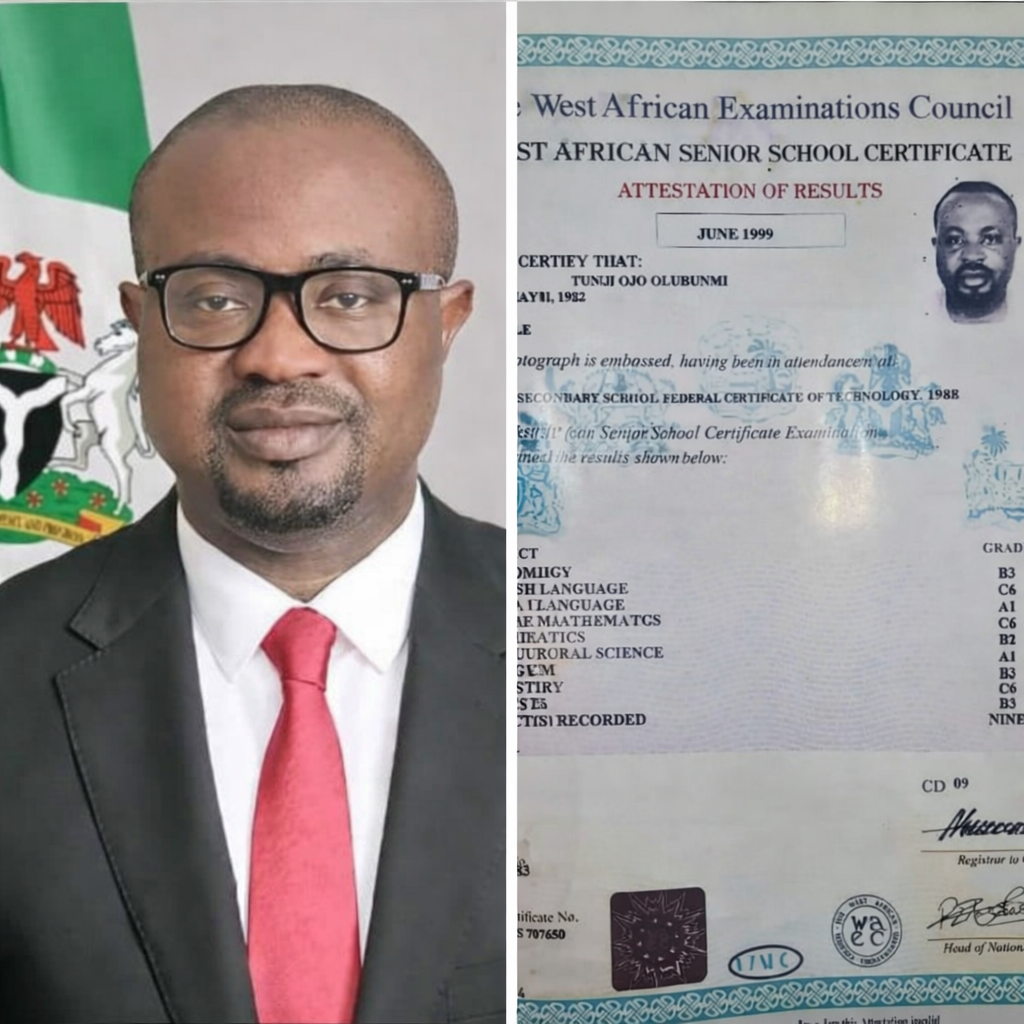
One issue that has drawn sharp scrutiny is the minister’s purported WAEC attestation dated 1999, which allegedly bears a passport photograph strikingly similar to his present day appearance.
Education and examination experts have questioned both the practice of attaching photographs to WAEC results in that era and the plausibility of such visual consistency across more than two decades. These anomalies, critics insist, warrant forensic examination rather than political dismissal.
The controversy takes on added urgency ahead of the Federal Government’s planned tax reform implementation from January 2026, which will require tighter integration of NINs with bank details. Civil society groups warn that public confidence in this reform could collapse if citizens believe that the very systems managing their identities and financial data are overseen by a minister facing unresolved allegations of document fraud.
“If a sitting minister accused of forging his own credentials is allowed to preside over national identity infrastructure, how safe are the identities of ordinary Nigerians?” one governance analyst asked.
Forgery is a criminal offence under Nigerian law, and established democratic practice demands that public officers facing serious, multi layered allegations step aside to allow unhindered investigation. Legal experts argue that doing so does not imply guilt but protects institutional integrity and public confidence.
The continued silence and refusal to subject credentials to transparent verification, critics say, only strengthens the perception of evasion.
At stake is more than one man’s career. This moment tests the administration’s commitment to rule of law, accountability, and national credibility. Nigeria cannot afford ambiguity at the helm of institutions responsible for identity, immigration, and internal security.
Until the allegations are conclusively addressed through independent and legally backed investigation, calls for Olubunmi Tunji-Ojo to step aside are likely to grow louder, both within and outside Nigeria.
In a democracy, silence is not a defence, and power is not immunity. The nation deserves clarity, not controversy.


