








By Dada Ayoola | Asiwaju Media Team
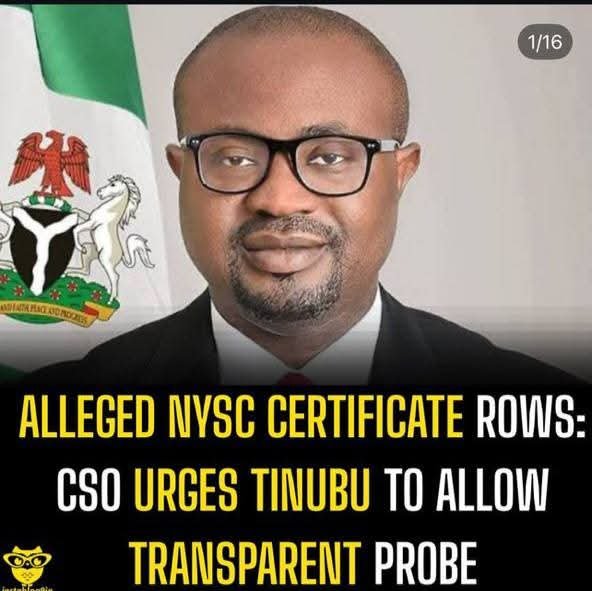
Allegations surrounding the academic and professional credentials of Nigeria’s Minister of Interior, Hon. Olubunmi Tunji-Ojo, have continued to generate intense national debate, with civil society groups and political stakeholders now openly demanding his resignation and an independent probe.
The Coalition of APC Support Groups in Ondo State (CASG) has announced plans for mass protests across the state, citing what it described as the minister’s prolonged silence in the face of serious credential related allegations. According to the group, the absence of a clear, factual response risks undermining public confidence in governance and casting a long shadow over Ondo State and the nation at large.
The allegations, which have circulated widely across traditional and social media platforms, raise questions about the authenticity of several documents linked to the minister. These include his Senior Secondary School Certificate (SSCE), bachelor’s degree, National Youth Service Corps (NYSC) discharge certificate, and a purported master’s degree.
CASG argues that the minister’s failure to publicly and conclusively address these claims has deepened public suspicion, a position strongly disputed by his allies with alleged 2 million Naira each to defend
Among the issues highlighted by critics is a WAEC attestation result allegedly dated 1999, which they claim bears features such as the inclusion of an adult passport photograph, that were not standard practice at the time. They argue that this inconsistency warrants official clarification from the relevant examination body.
Further scrutiny has been directed at the NYSC certificate associated with the minister. Critics reference provisions of the NYSC Act, which prohibit full time national service while holding elective political office. They allege that Tunji-Ojo’s claimed NYSC service coincided with his tenure as an elected member of the House of Representatives in 2019, and further contend that the service duration allegedly exceeded the statutory one year period.
In a related claim, critics allege that during the 2019 general elections, Tunji-Ojo submitted an SSCE, purportedly obtained from FUTA Staff Secondary School to the Independent National Electoral Commission (INEC) as his highest educational qualification for his House of Representatives bid.
This has raised further public questions over whether the NYSC would remobilise an individual whose declared highest qualification at the time was an SSCE, an issue critics insist requires clear institutional explanation.
Although none of the allegations has been conclusively determined by a court of law, they have triggered heightened concern due to the sensitive nature of the Interior Ministry, which oversees internal security agencies, immigration services, the correctional system, and the National Identification Number (NIN) database.
Some citizens have expressed growing anxiety over the integrity and security of their personal data, particularly as NINs become increasingly integrated with banking systems, taxation frameworks, and national security architecture.
Civil society organisations and concerned stakeholders are now calling on President Asiwaju Bola Ahmed Tinubu to order an independent, transparent, and time-bound review of the minister’s credentials and any related security implications. They argue that restoring public trust requires openness, accountability, and institutional clarity rather than prolonged silence.
Reactions within the ruling All Progressives Congress (APC) have been divided. While some party figures have urged that the issue be treated as a personal matter, others insist that the controversy has crossed into the realm of public accountability. An APC stakeholder, who spoke on condition of anonymity, alleged that several online defenders of the minister lack verifiable party affiliation and may be financially motivated, adding that a straightforward, document backed response would have resolved the matter if the credentials were indeed genuine and easily verifiable.
Political analysts warn that continued silence or opaque handling of the allegations could further erode confidence in public institutions and weaken public support for ongoing reforms, particularly those linked to national security and citizens’ data management.
As the controversy persists, public attention remains firmly fixed on whether the minister or the appropriate authorities will provide a decisive and transparent response capable of resolving the questions and reaffirming accountability as a cornerstone of democratic governance.


